Tuesday, 5 December 2017

CHAPTER 13

E-BUSINESS

The internet is a powerful channel that presents new opportunities for an organization      to:

      ➽ Touch customers
      ➽ Enrich products and services with information
      ➽ Reduce costs

 ⧭ How do e-commerce and e-business differ?

        ➤  E-commerce – the buying and selling of goods and services over the Internet                                           (online transactions)
        ➤  E-business – the conducting of business on the Internet including, not only buying                                  and selling, but also serving customers and collaborating with                                            business partners (online transactions, serving customers                                                  and collaborating with business partner)

 Industries Using E-Business


 E-business model – an approach to conducting electronic business on the Internet


haa23684_1403


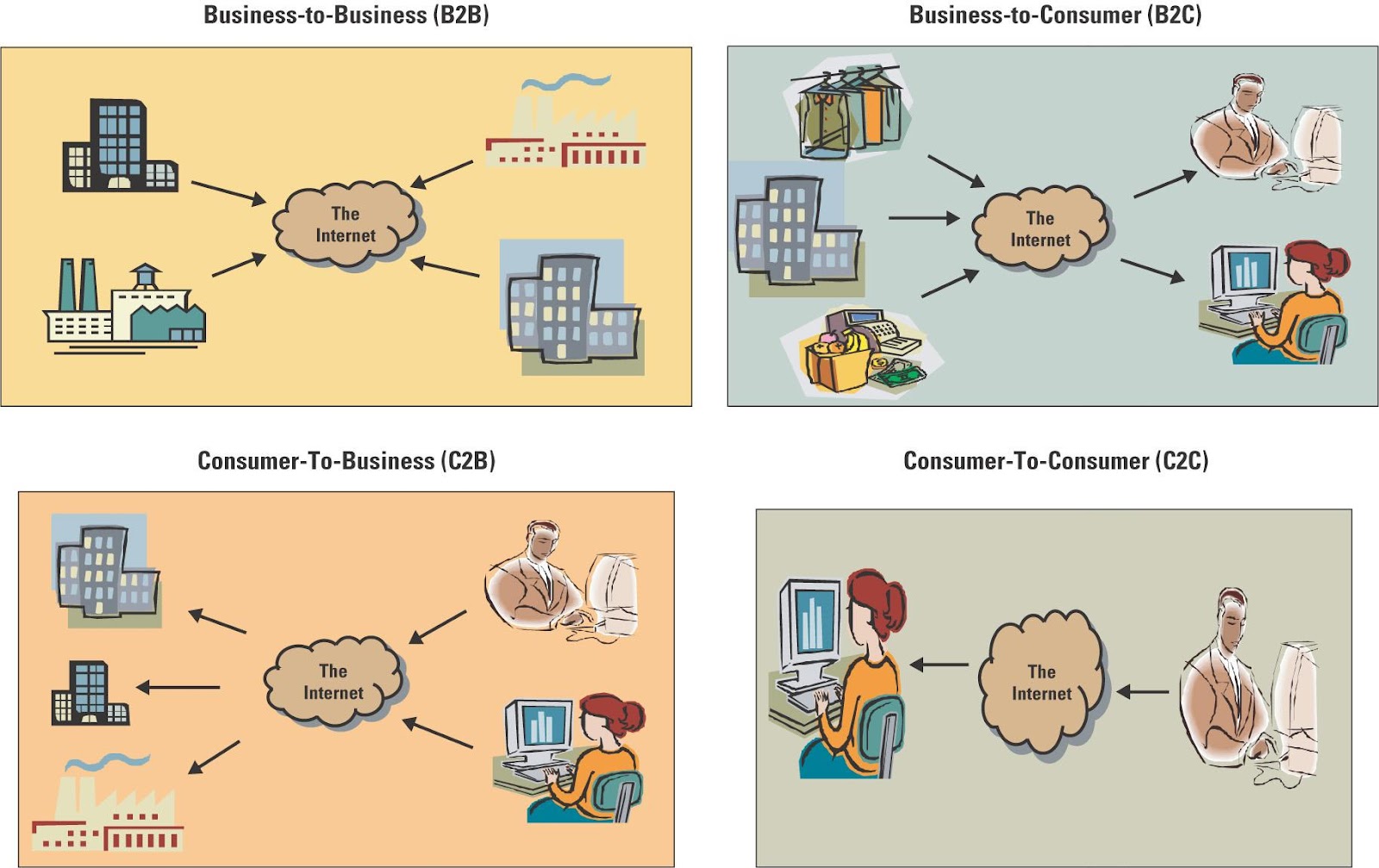
BUSINESS-TO BUSINESS (B2B)


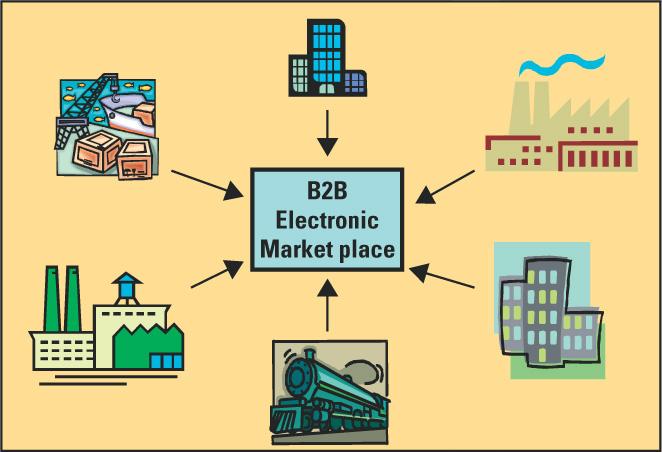
 Electronic marketplace (e-marketplace) – interactive business communities providing a central market where multiple buyers and sellers can engage in e-business activities

haa23684_1404


ELECTRONIC MARKETPLACE (E-MARKETPLACE)

πŸ”» Electronic marketplaces, or e-marketplaces, present structures for conducting commercial exchange, consolidating supply chains, and creating new sales channels

πŸ”» Their primary goal is to increase market efficiency by tightening and automating the relationship between buyers and sellers

πŸ”» Existing e-marketplaces allow access to various mechanisms in which to buy and sell almost anything, from services to direct material


ELECTRONIC MARKETPLACE


SEARCH ENGINE MARKETING


BUSINESS-TO-CONSUMER(B2C)

πŸ”Ί Common B2C e-business models include:
πŸ”½ e-shop – a version of a retail store where customers can shop at any hour of the day without leaving their home or office
πŸ”½ e-mall – consists of a number of e-shops; it serves as a gateway through which a visitor can access other e-shops


E-SHOP


E-MALL


BUSINESS-TO-CONSUMER(B2C)

➽Business types:
➼Brick-and-mortar business- operates in a physical store without an Internet presence. Eg: Bata.
➼Pure-play business- a business that operates on the Internet only without a physical store. Examples include fashionvalet.com.

    ➼Click-and-mortar business– a business that operates in a physical store and on the Internet .Eg: Hijabs by Hanami

    CarFax


    Amazon.com


    CONSUMER-TO-BUSINESS(C2B)

     ➧Priceline.com is an example of a C2B e-business model

     ➧The demand for C2B e-business will increase over the next few years due to customer’s  desire for greater convenience and lower prices

    PriceLine.com


    Agoda.com


    CONSUMER-TO-CONSUMER(C2C)

    ⧭ Online auctions :

     πŸ”Ό Electronic auction (e-auction) - Sellers and buyers solicit consecutive bids from each other and prices are determined dynamically

     πŸ”Ό Forward auction - Sellers use as a selling channel to many buyers and the highest bid
    wins

     πŸ”Ό Reverse auction - Buyers use to purchase a product or service, selecting the seller with the lowest bid

    ⧭ C2C communities include :


    πŸ”½Communities of interest - People interact with each other on specific topics, such as golfing and stamp collecting

    πŸ”½Communities of relations - People come together to share certain life experiences, such as cancer patients, senior citizens, and car enthusiasts

    πŸ”½Communities of fantasy - People participate in imaginary environments, such as fantasy football teams and playing one-on-one with Michael Jordan


    e-Bay


    Mudah.my


    E-BUSINESS BENEFITS


    E-Business benefits include:

    Highly accessible
         ➷Businesses can operate 24 hours a day, 7 days a week, 365 days a year
    Increased customer loyalty
         ➷Additional channels to contact, respond to, and access customers helps contribute            to customer loyalty
    Improved information content
         ➷In the past, customers had to order catalogs or travel to a physical facility before              they could compare price and product attributes. Electronic catalogs and Web pages
            present customers with updated information in real-time about goods, services, and          prices
    Increased convenience
        ➷E-business automates and improves many of the activities that make up a buying               experience
    Increased global reach
        ➷Businesses, both small and large, can reach new markets
    Decreased cost
        ➷The cost of conducting business on the Internet is substantially smaller than                      traditional forms of business communication

    E-BUSINESS CHALLENGES


    E-business challenges include:

    Identifying Limited Market Segments

    ⟴The main challenge of e-business is the lack of growth in some sectors due to product        or service limitation.

    Managing Consumer Trust

    ⟴Internet marketers must develop a trustworthy relationship to make that initial sale          and generate customer loyalty.

    Ensuring Consumer Protection
    ⟴Implement Internet Security, protect from misuse of customer information.

    Managing Consumer Trust
    ⟴Companies that operate online must obey a patchwork of rules about which customers      are subject to sales tax on their purchase and which are not.

    E-BUSINESS BENEFITS & CHALLENGES

    There are numerous advantages and limitations in e-business revenue models
    including:

    ➽Transaction fees
    ➽License fees
    ➽Subscription fees
    ➽Value-added fees
    ➽Advertising fees

    MASHUPS

    Web mashup - a Web site or Web application that uses content from more than
    one source to create a completely new service

       ⦽Application programming interface (API) - a set of routines, protocols, and tools for          building software applications

       ⦽Mashup editor - WSYIWYGs (What You See Is What You Get) for mashups


    Monday, 27 November 2017

    CHAPTER 12

    INTEGRATING THE ORGANIZATION FROM END TO END 
    (ENTERPRISE RESOURCE PLANNING)


    • At the heart of all ERP systems is a database, when a user enters or updates information in one module, it is immediately and automatically updated throughout the entire system

    • ERP systems automate business processes


    BRINGING THE ORGANIZATION TOGETHER


                                                ERP - Bringing the organization together


    THE EVOLUTION OF ERP


    INTEGRATING SCM, CRM AND ERP

    ➽ SCM, CRM & ERP are the backbone of e-business
    ➽ Integration of these applications is the key to success for many companies
    ➽ Integrations allows the unlocking of information to make it available to any user,                     anywhere, anytime
    ➽ SCM & CRM market overviews


    ➽ General audience and purpose of SCM, CRM & ERP

    INTEGRATION TOOLS

    πŸ”» Many companies purchase modules from an ERP vendor, an SCM vendor & a CRM                   vendor and must integrate the different modules together

           ⤇Middleware - several different types of software which sit in the middle of and provide                                      connectivity between two or more software applications
           ⤇Enterprise application integration (EAI) middleware - packages together commonly                 used functionality which reduced the time necessary to develop solutions that                           integrate applications from multiple vendors 

    πŸ”» Data points where SCM, CRM & ERP integrate


    ENTERPRISE RESOURCE PLANNING (ERP)

    ⧭ ERP systems must integrate various organization processes and be :
      
          ⏩ Flexible - must be able to quickly respond to the changing needs of the organization
          ⏩ Modular and open - must have an open system architecture, meaning that any                                                               module can be interface, with or detached whenever required                                                         without affecting the other modules
          ⏩ Comprehensive - must be able to support a variety of organizational functions for a                                                  wide range of businesses
          ⏩ Beyond the company - must support external partnerships and collaboration efforts


    ⧭ SAP boasts 20000 installations and 10 million users worldwide
    ⧭ ERP solutions are growing because :

         πŸ”½ ERP is a logical solution to the mess of incompatible applications that had sprung up in most businesses
         πŸ”½ERP addresses the need for global information sharing and reporting
         πŸ”½ ERP is used to avoid the pain and expense of fixing legacy systems


    Tuesday, 14 November 2017

    CHAPTER 11

    BUILDING A CUSTOMER -CENTRIC ORGANIZATION -CUSTOMER RELATIONSHIP MANAGEMENT (SCM)


    CUSTOMER RELATIONSHIP MANAGEMENT (SCM)

    • CRM enables an organization to:
      • Provide better customer service
      • Make call centers more efficient
      • Cross sell products more effectively
      • Help sales staff close deals faster
      • Simplify marketing and sales processes
      • Discover new customers
      • Increase customer revenues


    RECENCY, FREQUENCY, AND MONETARY VALUE
    • Organizations can find their most valuable customers through “RFM” - Recency, Frequency, and Monetary value
      • How recently a customer purchased items (Recency)
      • How frequently a customer purchased items (Frequency)
      • How much a customer spends on each purchase (Monetary Value)


    THE EVOLUTION OF CRM

    CRM reporting technology - help organizations identify their customers across other applications
    CRM analysis technologies - help organization segment their customers into categories such as best and worst customers
    CRM predicting technologies - help organizations make predictions regarding customer behavior such as which customers are at risk of leaving
    ➤ 3 phases in the evolution of CRM include reporting, analyzing, and predicting 

    haa23684_b0902


    haa23684_b0903

    THE UGLY SIDE OF CRM

    CUSTOMER RELATIONSHIP MANAGEMENTS'S EXPLOSIVE GROWTH
    haa23684_1101

    haa23684_1102

    USING ANALYTICAL CRM TO ENHANCE DECISIONS

    πŸ”Ί Operational CRM - supports traditional transactional processing for day-to-day front-office operations or systems that deal directly with the customers
    πŸ”Ί Analytical CRM - supports back-office operations and strategic analysis and includes all systems that do not deal directly with the customers


    Operational CRM and analytical CRM
    haa23684_1103

    CUSTOMER RELATIONSHIP MANAGEMENT SUCCESS FACTORS
    CRM success factors includes :
    1. Define information needs and flow
    2. Build an integrated view of the customer
    3. Implement in iterations
    4. Scalability for organizational growth

    CHAPTER 10

    EXTENDING THE ORGANIZATION- 
    SUPPLY CHAIN MANAGEMENT (SCM)

    SUPPLY CHAIN MANAGEMENT
    • The average company spends nearly half of every dollar that it earns on production
    • In the past,companies focused primarily on manufacturing and quality improvements to influence their supply chains
    BASIC OF SUPPLY CHAIN

     The supply chain has 3 main links :
    1. Materials flow from suppliers and their "upstream" suppliers at all levels
    2. Transformation of materials into semi finished and finished products through the organization's own production process
    3. Distribution of products to customers and their "downstream" customers at all levels
      Organizations must embrace technologies that can effectively manage supply chains


    INFORMATION TECHNOLOGY'S ROLE IN THE SUPPLY CHAIN
    • IT's primary role is to create integrations or tight process and information linkages between functions within a firm


    • FACTORS DRIVING SCM


    VISIBILITY
    • Supply chain visibility - the ability to view all areas up and down the supply chain
    • Bullwhip effect - occurs when distorted product demand information passes from one entity to the next throughout the supply chain


    CONSUMER BEHAVIOR
    • Companies can respond faster and more effectively to consumer demands through supply chain enhances
    • Demand planning software - generates demand forecasts using statistical tools and                                                                   forecasting techniques
    COMPETITION
    • Supply chain planning (SCP) software - uses advanced mathematical algorithms to improve                                                                       the flow and efficiency of the supply chain
    • Supply chain execution (SCE) software - automates the different steps and stages of the                                                                                supply chain
    • SCP and SCE in the supply chain


    SPEED
    • 3 factors fostering speed


    SUPPLY CHAIN MANAGEMENT SUCCESS FACTORS


    • SCM industry best practices include :
              πŸ”» Make the sale to suppliers
              πŸ”» Wean employees off traditional business practices
              πŸ”» Ensure the SCM system supports the organizational goals
              πŸ”» Deploy in incremental phases and measure and communicate success
              πŸ”» Be future oriented

    SCM SUCCESS STORIES
    • Top reasons why more and more executives are turning to SCM to manage  their extended enterprises


    • Numerous decision support systems (DSSs) are being built to assist decision makers in the design and operation of integrated supply chains
    • DSSs allow managers to examine performance and relationships over the supply chain and among :                                                                                                                                                          * Suppliers                                                                                                                                        * Manufacturers                                                                                                                              * Distributors                                                                                                                                    * Other factors that optimize supply chain performance


    CHAPTER 15

    Outsourcing in the 21st Century OUTSOURCING PROJECTS ⧭  Insourcing (in-house-development) – a  common approach using the professio...